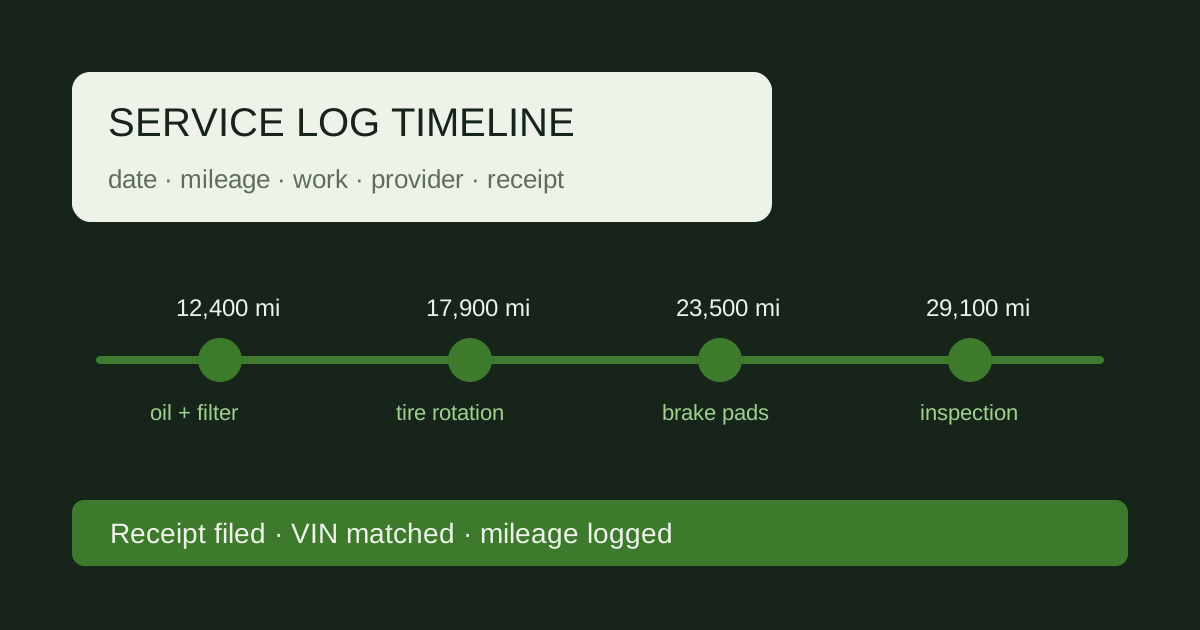
Using Service History for Resale Value and Warranty Claims
A complete service file does two jobs: it lets a buyer verify what was done to the vehicle and when, and it lets you prove to a manufacturer that scheduled maintenance happened inside the required window. Neither job depends on marketing language. Both depend on dated, VIN-matched paperwork that a stranger can read in under 10 minutes. This guide covers what a buyer inspects first, how to assemble a handover packet, how dated invoices support warranty claims, which gaps cause the most trouble, and what to hand over versus keep during a trade-in or private sale.
This page is the working guide of docautoservice.com, an independent site that collects and organizes vehicle service documentation practices: what a service log must capture, which papers prove maintenance, and how owners keep a complete vehicle history file. Nothing here is offered by a dealership, repair chain, or manufacturer; every practice described here is general consumer guidance, and official recall information comes from NHTSA while warranty-claim guidance comes from the FTC.
1. What a Buyer Checks First
An experienced used-car evaluator opens the file and looks at three things before reading a single repair description. First, mileage progression: the odometer readings on consecutive invoices should climb steadily. A jump from 42,000 mi on one dated invoice to 61,000 mi on the next, with 14 months between them, is a normal pattern; two invoices 3 months apart showing 88,000 mi then 71,000 mi is not. Second, recent major work: timing belt, water pump, transmission service, or clutch replacement within the last 30,000 mi signals the expensive jobs are behind the vehicle, not ahead of it. Third, tire and brake notes: an invoice that lists tread depth in 32nds of an inch and pad thickness in millimeters shows the shop measured, not guessed. Example figures like "7/32 in front, 5/32 in rear" or "4 mm front pads" are illustrative only and vary by vehicle and driving style.
A buyer also checks whether the same VIN appears on every invoice. If the file mixes two vehicles, the whole packet loses credibility. Keep one folder per VIN.
2. Building the Handover Packet
The packet is a physical or digital bundle you can hand to a buyer, a trade-in appraiser, or a warranty administrator. Five document types belong in it, each for a specific reason.
| Packet item | Why it is included |
|---|---|
| Service log export (CSV or PDF) with date, odometer, VIN, work performed, and shop name — 5 required fields | Gives a one-page chronology a reader can scan before opening individual invoices |
| Scanned invoices, one PDF per visit, named YYYY-MM-DD_VIN_last6.pdf | Preserves the dated proof behind every log line; naming convention prevents duplicate or missing entries |
| Recall completion proof (NHTSA campaign number and dealer repair order) | Shows open safety campaigns were closed, not deferred |
| Owner's manual plus spare-key note (key code location, number of keys on hand) | Confirms the buyer receives the maintenance schedule the records were measured against |
| Remaining-warranty paperwork (coverage start date, mileage limit, transferability clause) | Lets a buyer or administrator check whether the vehicle is still inside the manufacturer's term |
Keep at least 7 years of receipts for a vehicle you plan to sell or claim against, because many extended-coverage contracts and state lemon-law or emissions windows run that long. Example retention periods vary by contract; check your own documents.
3. Warranty Claims: How Dated Invoices Establish the Record
A warranty administrator asks one question: was the required service performed inside the specified interval, and who performed it? A dated invoice answers both. The date on the invoice fixes when the work occurred; the shop name and address fix who did it; the odometer reading fixes whether the interval was met. If your manual calls for oil changes every 7,500 mi or 12 months, whichever comes first, an invoice dated 11 months after the previous one with a 6,900-mi odometer increase sits inside the window. An invoice dated 15 months later with a 9,200-mi increase does not.
This site does not state warranty terms, because specific coverage, exclusions, and proof requirements come from the manufacturer's written contract, not from general guidance. Read your own warranty booklet and, for claim-process guidance, the FTC. What records do is make the timeline legible so a claim can be evaluated on facts.
4. Common Gaps That Hurt — and How to Fix Them
Three gaps cause most disputes. The first is an invoice without the VIN: a shop that writes only the license plate leaves the document unlinkable to the vehicle if plates were ever transferred. Fix: ask the shop to print the VIN on every invoice, or write it on the copy and initial it. The second is a mileage gap, for example a 10,000-mi stretch between two dated entries when the schedule called for service every 5,000 mi. Fix: add a dated note explaining the gap (storage, extended trip, or a missing receipt) and request a duplicate invoice from the shop's records. The third is an unreadable scan: a 72-DPI phone photo where the odometer and date are smudged. Fix: rescan at 300 DPI, black-and-white, one page per PDF, and verify the date, odometer, and VIN are legible before filing.
Going forward, log each visit within 7 days and store the PDF in two places — a local folder and a cloud folder — so a lost phone does not erase the file.
5. During a Trade-In or Private Sale: What to Hand Over vs. Keep
You decide whether to give originals or copies. A common practice is to hand over copies and keep originals until the transaction closes, then transfer originals if the buyer asks. Use this ordered checklist.
- Print or export the service log as a single PDF and label the first page with the VIN, current odometer, and date prepared.
- Assemble scanned invoices in date order; confirm each shows date, odometer, VIN, shop name, and work performed.
- Include recall completion proof with the NHTSA campaign number for each closed recall.
- Add the remaining-warranty paperwork and note the coverage start date and mileage limit.
- Note the number of keys and the spare-key code location on a single sheet.
- Keep one complete copy of everything for your own file, including a photo of the odometer at handover.
- If you keep originals, give the buyer a written list of what you retained and offer to send originals after payment clears.
6. FAQ
Do I need every single oil-change receipt? No, but you need enough dated entries to show the interval was met. If the schedule is every 7,500 mi, missing one receipt in a 60,000-mi history is usually explainable; missing four consecutive ones is harder to defend.
Can a buyer verify my records independently? Sometimes. A shop can confirm it performed work if you authorize release. NHTSA recall status can be checked by VIN at NHTSA, independent of your file.
What if a shop refuses to put the VIN on the invoice? Ask for a separate service summary that includes the VIN, or write the VIN on your copy, date it, and initial it. A dated, VIN-matched note is better than an unlinkable receipt.