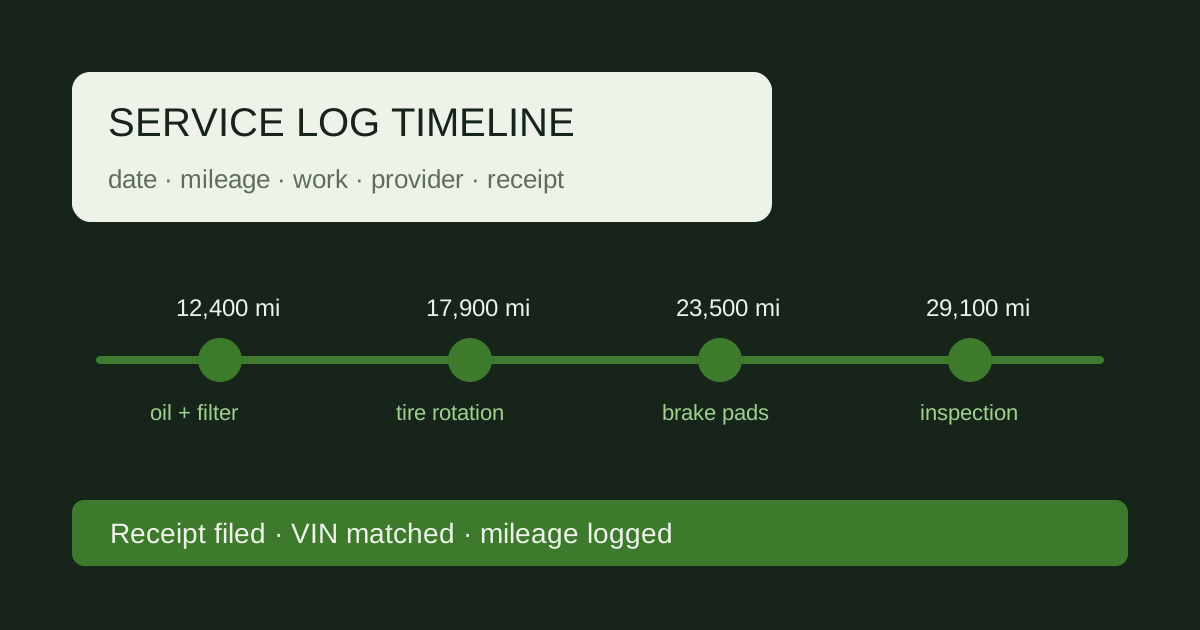
Vehicle Service Log: Fields, Mileage Tracking, and a Worked Example
A vehicle service log is a dated, odometer-anchored record of every maintenance event performed on one vehicle, kept by the owner rather than the shop. It answers three questions a stack of loose invoices cannot: what was done, at what mileage, and what document proves it. The guide below covers the seven columns of a complete log entry, a worked 12-month example, the differences between DIY and shop entries, how a reviewer reads odometer progression, where to keep the log, and three common questions.
This page is the working guide of docautoservice.com, an independent site that collects and organizes vehicle service documentation practices: what a service log must capture, which papers prove maintenance, and how owners keep a complete vehicle history file. Nothing here is offered by a dealership, repair chain, or manufacturer; every practice described here is general consumer guidance, and official recall information comes from NHTSA while warranty-claim guidance comes from the FTC.
1. Anatomy of a service log entry
Every row in a service log carries the same seven columns. Omitting any one of them breaks the chain between the work performed and the paper that proves it.
| Column | What goes in it | Common mistake |
|---|---|---|
| Date | Calendar date the work was completed, not the date the appointment was booked. | Using the invoice-print date, which can lag the service date by days. |
| Odometer | Mileage reading at drop-off, in mi (e.g. 42,318 mi). | Copying the mileage from the previous entry instead of reading the dash. |
| Service type | The named operation: oil and filter change, tire rotation, front brake pad replacement, annual safety inspection. | Writing "maintenance" or "checkup" with no named operation. |
| Provider | Shop name, independent garage, or "self" for DIY work. | Leaving it blank when the same shop performs repeat work. |
| Parts | Part description and quantity, e.g. 5 qt of 0W-20 oil, one oil filter, two front pads. | Recording only "parts" with no quantity or specification. |
| Cost | Amount paid in $, including tax, or $0 for warranty work. | Entering the estimate rather than the final invoice total. |
| Receipt ref. | Invoice number, or a file name for a scanned PDF. | Storing the receipt without any reference tying it to the row. |
Five of these fields — date, odometer, service type, provider, and receipt reference — are the minimum that makes a log defensible. The other two add cost history and parts traceability.
2. A worked 12-month example
The table below is an illustrative schedule for one compact sedan driven roughly 1,100 mi per month. It is an example, not a manufacturer's prescription; exact intervals come from the owner's manual for the specific vehicle. The odometer column increases monotonically, which is the property a reviewer checks first.
| Month | Odometer | Service type | Provider | Parts | Cost | Receipt ref. |
|---|---|---|---|---|---|---|
| Month 1 | 30,120 mi | Oil and filter change | Independent garage | 5 qt 0W-20, 1 filter | $68 | INV-4471 |
| Month 2 | 31,240 mi | Tire rotation | Independent garage | None | $25 | INV-4502 |
| Month 4 | 33,410 mi | Oil and filter change | Self | 5 qt 0W-20, 1 filter | $41 | DIY-2024-04 |
| Month 6 | 35,690 mi | Front brake pad replacement | Independent garage | 2 front pads, 2 rotors | $412 | INV-4633 |
| Month 8 | 37,880 mi | Oil and filter change, tire rotation | Independent garage | 5 qt 0W-20, 1 filter | $89 | INV-4718 |
| Month 10 | 40,050 mi | Annual safety inspection | State inspection station | None | $35 | INS-88214 |
| Month 12 | 42,318 mi | Oil and filter change | Independent garage | 5 qt 0W-20, 1 filter | $68 | INV-4809 |
Oil changes land at intervals between 2,170 mi and 2,290 mi in this compressed example, well inside the common 3,000-7,500 mi range; a real log would space them across the full year. The inspection entry carries a state-issued receipt number rather than a shop invoice, which is normal and should still be referenced in the same column.
3. DIY vs shop entries
Shop entries arrive with documentation the owner did not create: a printed invoice showing the shop's name, the VIN, the odometer at drop-off, a parts list with part numbers, and labor hours. The owner's job is to transcribe the date, odometer, service type, and cost into the log and file the invoice under its number.
DIY entries require the owner to generate that documentation. Three fields change meaning:
- Provider becomes "self" plus the location, e.g. "self — home garage."
- Parts must carry the part number and the receipt, because no shop record exists to fall back on. Keep the parts-store receipt stapled to a photo of the odometer reading.
- Notes should record the specification used — oil viscosity, torque value from the service manual, fluid type — quoted from the manual, not from memory. This page does not describe how to perform any repair; it only records what was done.
A DIY entry with no part number and no receipt is functionally invisible to a future buyer or warranty reviewer.
4. Mileage sanity check
A consistent odometer progression reads as credible because the monthly deltas fall in a narrow band. In the example above, the gaps run 1,120 mi, 2,170 mi, 2,280 mi, 2,190 mi, 2,170 mi, and 2,268 mi — all plausible for a single daily driver. A reviewer scanning the column asks one question: does any gap imply the car sat unused or was driven implausibly far?
The failure pattern to avoid is a 15,000-mile gap between two dated entries with no explanation. That gap suggests either a missing record or an odometer discrepancy, and it is the single most common reason a service log gets questioned. A second pattern is an invoice without the VIN: if the shop's paperwork does not identify the vehicle, the entry cannot be matched to the car and the row is effectively unproven. Keep a note column for legitimate long gaps — a stored vehicle, a deployment, a long trip — so the reason is on the page rather than in the owner's memory.
5. Where to keep it
Three formats work, and all three must carry the same five fields: date, odometer, service type, provider, and receipt reference.
Spreadsheet template. Seven columns matching Section 1, one row per event, sorted by odometer. A spreadsheet supports filtering by service type and lets a reviewer see the full progression at a glance. Keep the file in cloud storage and name it with the VIN, e.g. VIN-service-log.xlsx.
Paper notebook. One line per event with the receipt number written in the margin. Works without power and is easy to hand to a buyer, but it cannot be sorted and a lost notebook loses the whole history.
Phone notes. Fastest to capture at the service counter, but the weakest long-term store. Use it as a capture layer, then transcribe into the spreadsheet within the same week. A phone note with no receipt reference is a reminder, not a record.
Whichever format is used, the paper trail should be retained for at least 7 years, because that is the window in which a warranty or resale dispute can still surface.
6. FAQ
How often should the log be updated? After every service event, before leaving the parking lot. Transcribing at the counter takes about two minutes and prevents the receipt from being filed without a matching row.
What if a shop refuses to give the odometer reading? The owner can read the dash and write it in the log; the shop's invoice number still serves as the receipt reference. The odometer value does not depend on the shop's cooperation.
Do DIY entries count as proof of maintenance? They count if they name the part, the specification, and the date, and if a receipt supports the parts purchase. An entry that says only "oil change" proves nothing.
Four document types anchor the whole file: the service log itself, the receipts, the parts invoices, and the inspection certificates. Keep all four together under the VIN.